Yes, you can fly with a gun in the United States. Thousands of hunters, competitors and everyday gun owners do it every week, and it is usually a non-event at the counter. The people who end up in trouble almost always miss one small rule: a loose round in a range bag, a case that pops open without a key, a layover in the wrong state, or a magazine left in a carry-on.
This guide covers every step, from packing the case the night before to picking it up at baggage claim. It covers the TSA rules, what the airlines add on top, the state law problems most guides skip, and a checklist you can run through before you leave the house.
The short answer
To fly with a gun on a U.S. airline:
- Unload the firearm completely, with nothing in the chamber, the cylinder or an inserted magazine.
- Lock it in a hard-sided case that cannot be pried open, and keep the only key or combination yourself.
- Pack the ammunition in a box made for ammunition, in checked baggage only, within your airline's weight limit.
- Check the case as checked baggage and declare it to the airline at the ticket counter. Never bring it to the security checkpoint.
- Make sure the gun is legal where you land, and anywhere you might be stuck overnight on a layover.
Everything below explains how to do each step without surprises.
The TSA rules in plain English
The Transportation Security Administration sets the floor for every airline. The official TSA firearms page is short, and these are the parts that matter:
- Checked baggage only. Firearms are never allowed in a carry-on or on your body past the checkpoint, even with a concealed carry permit.
- Unloaded. TSA counts a gun as loaded if there is a live round, or any part of one, in the chamber, in the cylinder or in a magazine inserted in the gun.
- Locked hard-sided container. The case must completely secure the firearm. TSA says locked cases that can be easily opened are not permitted.
- You keep the key. Only you should have the key or combination, unless a TSA officer asks for it to inspect the case.
- Declare it. Every firearm must be declared to the airline when you check the bag.
- Parts count too. Magazines, clips, bolts and firing pins are not allowed in carry-on bags. Pack them in checked baggage. Rifle scopes are the exception and can go in either bag.
- Replicas count too. Realistic replicas, BB guns and airsoft guns are banned from carry-on bags as well and must be checked.
How to pack your gun case
Pick the right case
Use a hard case with a rigid shell, a solid hinge and lockable hasps. A quality hard rifle or pistol case is ideal. If the lid can be flexed open at the corners while it is locked, it will not pass. Many travelers lock a small hard pistol case inside a larger checked suitcase, which keeps the gun case out of sight on the carousel. If you do that, the inner pistol case is the one that must be hard-sided and locked.
Use the right lock
Because only you should hold the key or combination, use your own padlocks on the gun case rather than TSA-accessible luggage locks. Lock every hasp. A case with two hasps and one lock leaves a gap someone can pry open, and an agent may refuse it.
Pack the ammunition the right way
Ammunition can never go in a carry-on. In checked baggage it must be in a fiber (cardboard), wood, plastic or metal box made to carry ammunition. The factory cardboard box is fine. A plastic ammo case with a snap lid also works. Loose rounds rattling in a bag pocket do not.
TSA allows ammunition in the same locked case as the gun, as long as it is boxed. Magazines, loaded or empty, must be boxed or packed inside the locked hard case with the unloaded firearm. Some airlines are stricter about loaded magazines, so check yours before you load any.
What not to pack
Gunpowder, black powder and percussion caps are not allowed in either bag. Neither are flares, incendiary ammunition such as tracers, or anything that counts as an explosive. If you reload, leave the powder at home.
Airline rules: what changes from carrier to carrier
TSA rules are the minimum. Each airline adds its own, and they are not identical. Before every trip, read your airline's firearms page and check these points:
- Ammunition weight. Most major U.S. airlines cap ammunition at 11 pounds (5 kg) per passenger, packed in its box. Weigh it at home.
- How many guns per case. Some carriers limit how many firearms can share one case or how many cases one person can check.
- Loaded magazines. Some airlines treat a loaded magazine as acceptable ammunition packaging only if it is fully enclosed. Others want magazines empty.
- Fees. A gun case is normally charged like any other checked bag. A long rifle case may count as oversized.
- Check-in. Firearms must be declared at the ticket counter. Curbside and kiosk-only check-in usually will not work.
- International flights and partners. Rules can change when a codeshare partner operates part of your trip. The operating carrier's rules apply.
Step by step at the airport
- Arrive early. Give yourself an extra 30 to 45 minutes. Declaring a firearm takes longer than dropping a bag, and some airports have only a few agents trained to process it.
- Go to the ticket counter. Tell the agent: "I have a firearm to declare." Say it plainly and calmly. Do not open the case or take anything out unless the agent asks.
- Sign the declaration. The agent gives you a firearm declaration tag. You sign it to confirm the gun is unloaded, and it goes inside the case. It should never be on the outside of a bag, where it tells everyone what is inside.
- Lock it back up. Relock every hasp yourself and keep the keys or combination.
- TSA screening. Some airports have you wait at the counter until the bag clears. Others ask you to walk it to a TSA screening area. If TSA needs to open the case, they will call you to unlock it. Stay nearby until you are told you can go.
- Go through security as normal. Before you get in line, check every pocket of your carry-on and jacket for loose rounds, an empty magazine or a holster you forgot. This is where most people get caught.
Picking up your gun at your destination
At many airports, firearms do not come out on the carousel. They are held at the airline's baggage service office, and you show ID to collect the case. If your case does not appear, go straight to the baggage office instead of waiting at the belt.
Open the case somewhere private, check that everything is there and undamaged, and report any problem before you leave the airport. Then follow the local law for carrying or transporting the gun from the airport to where you are staying.
State and local laws: the part that gets people arrested
TSA and the airline only care about getting the gun safely onto the plane. Once you land, state and local law takes over, and this is where good people get into real trouble.
- Destination laws. Before you fly, confirm your firearm, its magazines and your ammunition are legal where you land. Some states limit magazine capacity, restrict certain rifles and some types of ammunition, or require a permit simply to possess a handgun.
- Federal safe passage. The Firearm Owners Protection Act (18 U.S.C. 926A) protects travelers passing through a state, but only if the gun is legal at both the start and the end of the trip and is unloaded and not readily accessible. It is a defense, not a guarantee, and it has not always protected travelers stuck overnight.
- Layovers and lost bags. The riskiest moment is a layover that turns into an overnight stay, or a lost bag you have to collect, in a strict state. Book nonstop or connect through firearm-friendly states when you can. If a connection is cancelled, ask the airline to keep your bag in its custody rather than handing it to you.
- Carry permits. Your permit lets you carry where it is valid. It does not let you carry at the airport checkpoint, and it may not be honored at your destination. Check reciprocity before you go.
What happens if you bring a gun to the checkpoint by mistake
TSA officers find thousands of firearms in carry-on bags every year, and most of them are loaded. Almost every one of those owners says the same thing: "I forgot it was in there." The consequences are real:
- A TSA civil penalty that can reach about $15,000. An unloaded gun with ammunition in the same bag is fined the same as a loaded gun.
- Loss of TSA PreCheck for at least five years.
- Possible arrest and criminal charges under local law, depending on the airport.
- A missed flight at minimum, because the police respond first.
The fix is a habit: a range bag is never your carry-on. Empty and check any bag you take to the range before you pack it for a trip.
Flying internationally with a firearm
International travel with a firearm is possible but takes weeks of planning. Most countries require an import permit issued before you arrive, and many will not allow handguns at all. Before you leave the U.S., register your firearm with U.S. Customs and Border Protection on CBP Form 4457, so you can bring it back home without questions about where it came from. Check the destination country's embassy rules, your airline's international policy and the rules of any country where you change planes.
Make your case speak for itself
Most delays at the counter happen when an agent is new or unsure of the rules: a question about magazines, about ammo in the case, or about which form to use. You can explain it yourself, but it is easier when you can show it.
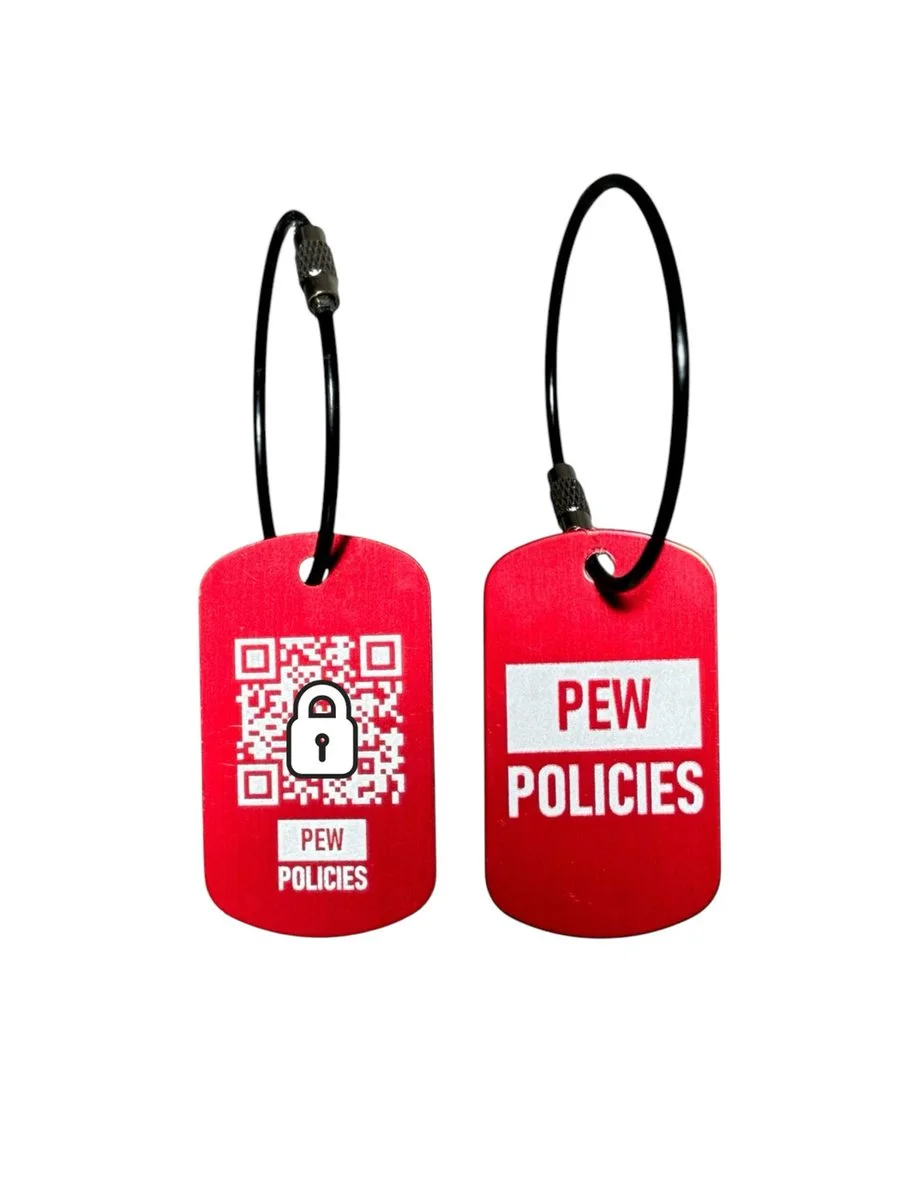
That is why we carry Pew Policies firearm case luggage tags. Each tag has a QR code that opens an up-to-date guide to airline firearm policies, TSA requirements and state reciprocity. If a question comes up at the ticket counter, an agent can scan the tag and see the current policy for your airline right there, instead of guessing or calling a supervisor. The tags come in a pack of two, one for the hard case and one for the outer bag.
Your flying-with-a-firearm checklist
- Firearm unloaded: chamber, cylinder and magazine well checked twice.
- Hard-sided case locked on every hasp, with locks only you can open.
- Ammunition in factory boxes or a proper ammo case, under your airline's weight limit (usually 11 pounds).
- Magazines packed the way your airline allows.
- No powder, primers or percussion caps anywhere in your luggage.
- Airline firearm policy read for this trip, including any partner airline.
- Destination and layover laws checked for the gun, the magazines and the ammo.
- Carry-on, jacket and range bag pockets emptied of rounds, magazines and holsters.
- Keys or combination on you, not in the checked bag.
- Extra time planned at the ticket counter.
- Pew Policies tags on the case, so the current rules are a scan away.
Frequently asked questions
Can I fly with a gun in my carry-on?
No. Firearms, ammunition, magazines and firearm parts other than rifle scopes are prohibited in carry-on bags. A gun must travel unloaded, in a locked hard-sided case, as checked baggage, declared at the ticket counter.
Can ammunition go in the same case as the gun?
Yes. TSA allows ammunition in the same locked hard case as the unloaded firearm, as long as it is packed in a box made for ammunition. Check your airline for its weight limit, which is usually 11 pounds per passenger.
Can I use a TSA lock on my gun case?
Use your own locks. TSA says only the passenger should keep the key or combination to a firearm case, unless an officer asks for it during an inspection. Stay near the counter so you can open the case if you are called.
Do I need a carry permit to fly with a gun?
Not to check it. A permit does not let you carry past the checkpoint, and it may not be valid where you land. What matters is that the firearm is legal to possess at your destination and anywhere you might be stuck on a layover.
Does the declaration tag go on the outside of the case?
No. The airline's firearm declaration goes inside the locked case. Nothing on the outside of your bag should announce that it holds a gun.
What happens if I forget a gun in my carry-on?
Expect police at the checkpoint, a missed flight, a TSA civil penalty that can reach about $15,000, loss of TSA PreCheck for at least five years, and possible criminal charges under local law.
How early should I get to the airport when flying with a firearm?
Add 30 to 45 minutes to your usual arrival time. Declaring a firearm takes longer than a normal bag drop, and some airports have you wait until TSA clears the case.
Rules change. This guide is general information, not legal advice. Always check the current TSA rules, your airline's firearm policy and the law at your destination before you fly.